
3D CAD Viewer for the Aerospace Industry
High-Performance Enterprise 3D CAD Visualization for Aircraft Manufacturing and Aerospace Engineering
At a Glance: KISTERS 3DViewStation is a high-end visualization solution that enables high-performance access to large CAD data sets in the civil aerospace sector and accelerates cross-departmental collaboration. It enables engineers, inspectors, and technical writers to review, analyze, and approve massive CAD models—ranging from highly complex aircraft components and VIP cabins to complete airframes or satellite buses—across different systems. In this way, 3DViewStation boosts the efficiency of downstream engineering and quality processes, from precise measurement to the creation of technical documentation.
By eliminating the need for costly CAD authoring licenses outside of the design department, civil OEMs, Tier 1 system suppliers, and maintenance, repair, and overhaul (MRO) companies can sustainably reduce their IT costs. At the same time, the solution strengthens trust in cross-departmental collaboration, drastically shortens all quality-related analysis cycles, and thus increases efficiency in civil aviation.
- Core applications: Drawing-free component and PMI verification (MBD), visualization of aerospace structures, interior and cabin customization, retrofit and P2F (passenger-to-freighter) conversions, commercial satellite structure analyses, and maintenance and documentation processes
- Specialized multi-CAD engine: Native import of complex assemblies from CATIA V5/V6, Siemens NX, PTC Creo, and open industry standards (STEP AP242 / JT), including full evaluation of integrated 3D PMI. Over 180 measurement, sectioning, and inspection tools are available as a core feature of the solution and can be used intuitively.
- Optimized downstream processes: Secure, cross-departmental provision of validated 3D CAD geometries for quality inspection (FAI), purchasing, work planning (AV), assembly, after-sales, and field operations in the hangar.
We will be happy to advise you
Sales Germany
+49 2408 9385 517
Sales USA
+1 916 723 1441
Why 3DViewStation? An overview of the key benefits:
- Handling massive amounts of data (Big CAD / Large Model Visualization / DMU):
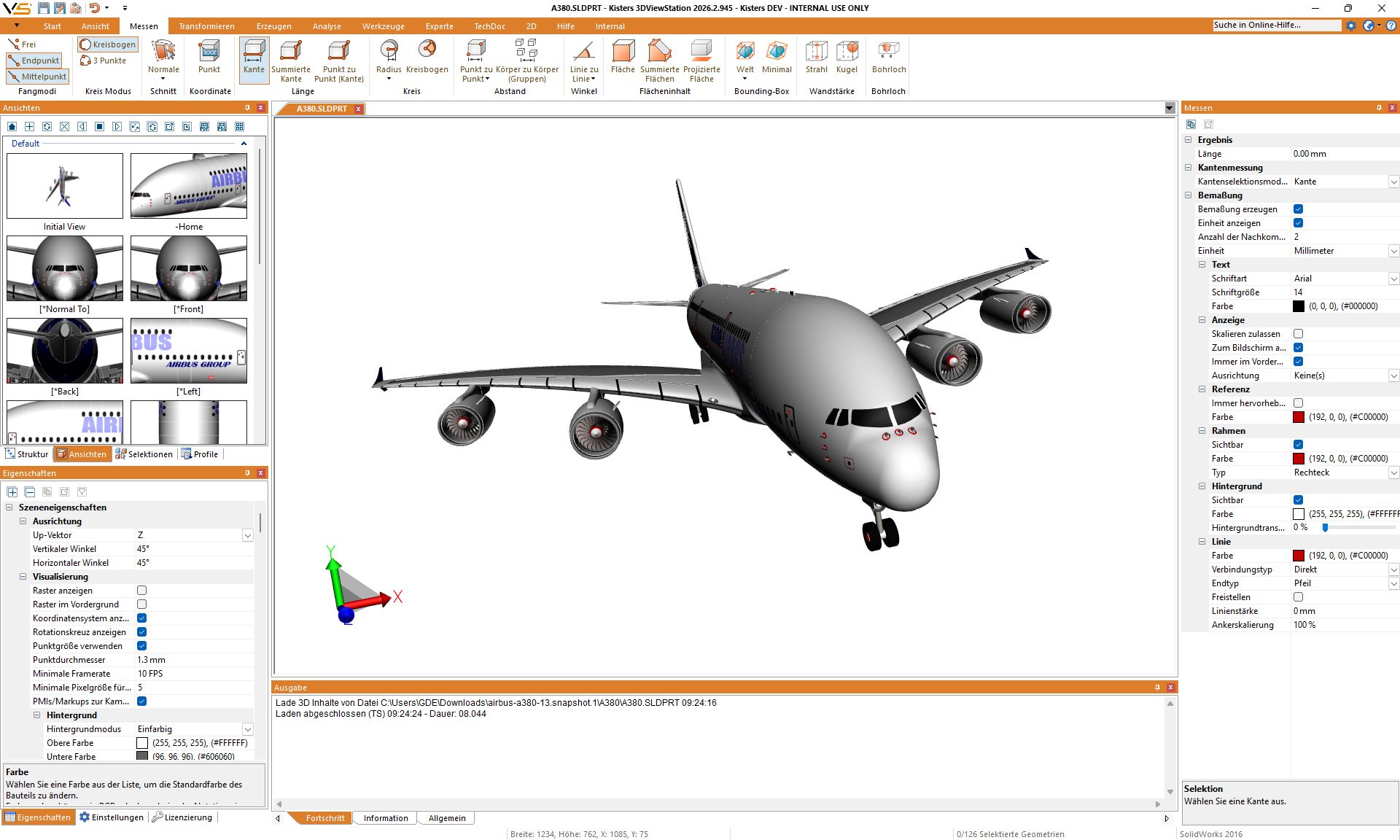
- The 3D CAD viewer opens even gigabyte-sized datasets of commercial aircraft, helicopters, or commercial spacecraft—containing millions of individual parts—with exceptional performance, enabling smooth visualization, measurement, and inspection processes across all downstream departments.
- MBD & STEP AP242 Benchmark:
- Seamless display of Model-Based Definition (MBD) and 3D PMI (Product and Manufacturing Information) to ensure consistent implementation of paperless manufacturing and to generate downstream documentation or inspection specifications directly from the 3D model. Evaluation and verification of attributes for long-term archiving.
- Consistent IP Protection:
- Reliable anonymization of sensitive 3D geometries prior to sharing with global supply chains through the removal of non-visible parts, geometric distortion, reducing tessellation, automated shrinkwrap generation, and anonymization functions—with the ability to share data with external partners in a controlled manner without compromising quality or security requirements. In addition, pixel streaming makes it possible to provide a view of the data without having to download the geometries to the end device in any form.
- Significant savings on licensing costs:
Replacement of expensive CAD authoring licenses in all downstream departments outside of pure design by up to 80%.

Challenges in the Civil Aerospace Supply Chain: Mega-Assemblies, 3D Models, and Zone Approvals
The civil aerospace sector—ranging from commercial passenger aviation to regional aircraft manufacturing and satellite technology—is subject to extremely stringent quality and safety standards (such as AS9100). Whether it’s the integration of new hydrogen and SAF (Sustainable Aviation Fuels) engines, the expansion of urban air mobility fleets (eVTOL), or the mass production of commercial satellite constellations: development cycles must be shortened, while absolute zero-defect tolerance applies. At the same time, production and supply chains worldwide are under intense pressure to improve efficiency.
In practice, civil OEMs, engine manufacturers, and specialized Tier 1/2 suppliers collaborate in heterogeneous CAD environments. Evaluating massive assemblies across departments using these different systems requires a neutral, high-performance visualization layer.
Try 3DViewStation for 30 Days
High-performance 3D CAD viewing on Desktop and Web. Full feature set, no commitment and instant access.
Download free trial now
Challenges in Aerospace Digital Mockups (DMU)
| Aerospace Challenge | Impact in Practice | Benefits of the 3DViewStation Viewer |
| Gigantic Amounts of Data (Big CAD) | Complete models of aircraft airframes or engines overload conventional standard viewers. | Visualize millions of individual parts in a matter of seconds without any performance degradation. |
| Model-Based Definition (MBD) | 2D drawings are eliminated; tolerances are embedded directly in the geometry as 3D PMI. | Seamless reading and display of form and position tolerances according to STEP AP242 and JT for paperless manufacturing. |
| Border Clearances & FAI Inspections | First-article inspections require a comparison of the actual part and the CAD model using precise measurements of critical areas. | A visual 3D comparison of 3D scans with the original CAD design data, providing a clear result of the inspection. |
| IP Protection in Global Supply Chains | Sensitive geometries (e.g., the inner surfaces of turbine blades) must not protrude outward. | Automatic generation of protected packaging (shrink wrap) for secure release to suppliers. |
Paperless Manufacturing & Data Availability: The 3D Model as the Single Source of Truth
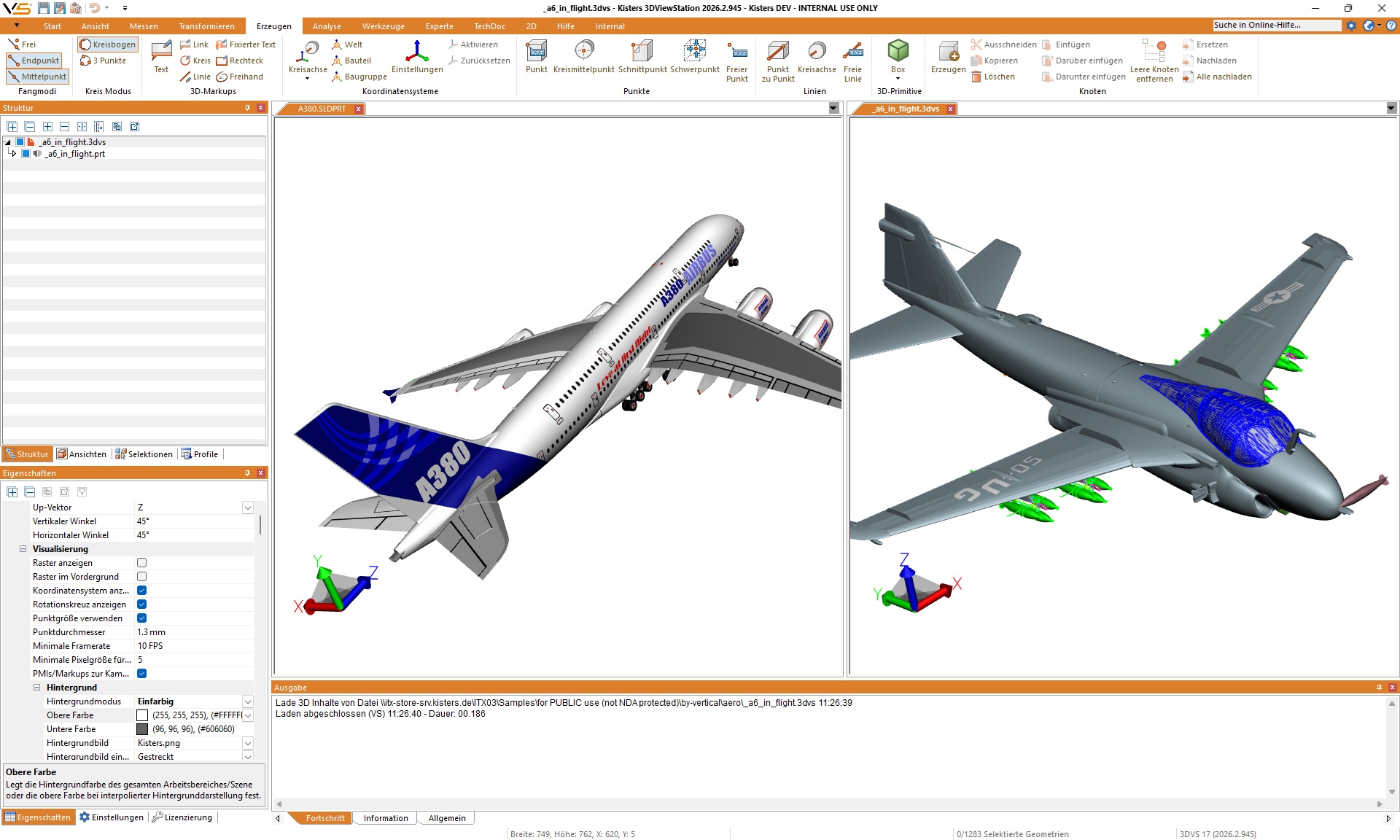
In modern aircraft manufacturing, the 3D model serves as the indisputable single source of truth. All manufacturing information (PMI) is digitally linked to the component, enabling work planning, quality assurance, documentation, and various manufacturing methods to operate on the same data foundation. If production planners, quality control engineers, or assembly workers on the Final Assembly Line (FAL) do not have direct access to this data, the production flow comes to a standstill.
This is precisely where 3DViewStation, as a central enterprise CAD viewer, resolves the bottleneck: It serves as a tool for consistent downstream processes and offers the necessary flexibility for different workflows and departments by making complex MBD data from CATIA V5/V6, Siemens NX, Creo, or STEP AP242 visible and analyzable for all downstream departments at the click of a button—accurately, efficiently, and without expensive CAD design licenses. Viewers enable collaboration without license costs for employees, thereby laying the foundation for fast, cross-departmental decision-making throughout the entire company.
Real-World Applications in the Aerospace Industry
1. Installation Inspection: Engine, Cabin, and Aircraft Components
When interdisciplinary teams from engine design, structural mechanics, and cabin interiors come together, hundreds of interfaces and components in various areas of the aircraft must be visualized with millimeter precision. 3DViewStation serves as a powerful verification tool: It calculates clearances within the tightly packed fuselage, performs dynamic cuts through dense composite structures (CFRP), accounts for different materials and component requirements during installation verification, and makes a wide variety of aircraft components clearly visible within the virtual assembly space. Mounts and other components can also be precisely verified there. Automatic collision checks help identify assembly problems early on and avoid costly rework at the interface between the structure and the interior. Consistent early error detection during the digital development phase reduces the need for changes and thus significantly lowers subsequent adjustment costs in the physical model. During installation testing, 3D scans can also improve the design and performance of aircraft components and offer the potential for better design and testing decisions through early error detection.
2. Final Assembly (FAL) & First Article Inspection (FAI)
Uncompromising safety requirements demand precise validation before assembly approval on the final assembly line. Using 3DViewStation, quality inspectors compare high-resolution 3D scans of manufactured parts directly with the original CAD target geometry for earlier defect detection. State-of-the-art 3D scanners capture the finest details with an accuracy of up to 0.020 mm—a physical measurement process that typically takes several hours per assembly or aircraft segment.
3DViewStation then eliminates the critical software bottleneck: It processes even massive scan point clouds (converted to meshes) and target CAD geometries without noticeable loading times, performs the mathematical target-actual comparison in seconds, and immediately highlights critical deviations in the sub-millimeter range using a false-color heatmap.
3. Efficient MRO (Maintenance, Repair, and Overhaul) Processes
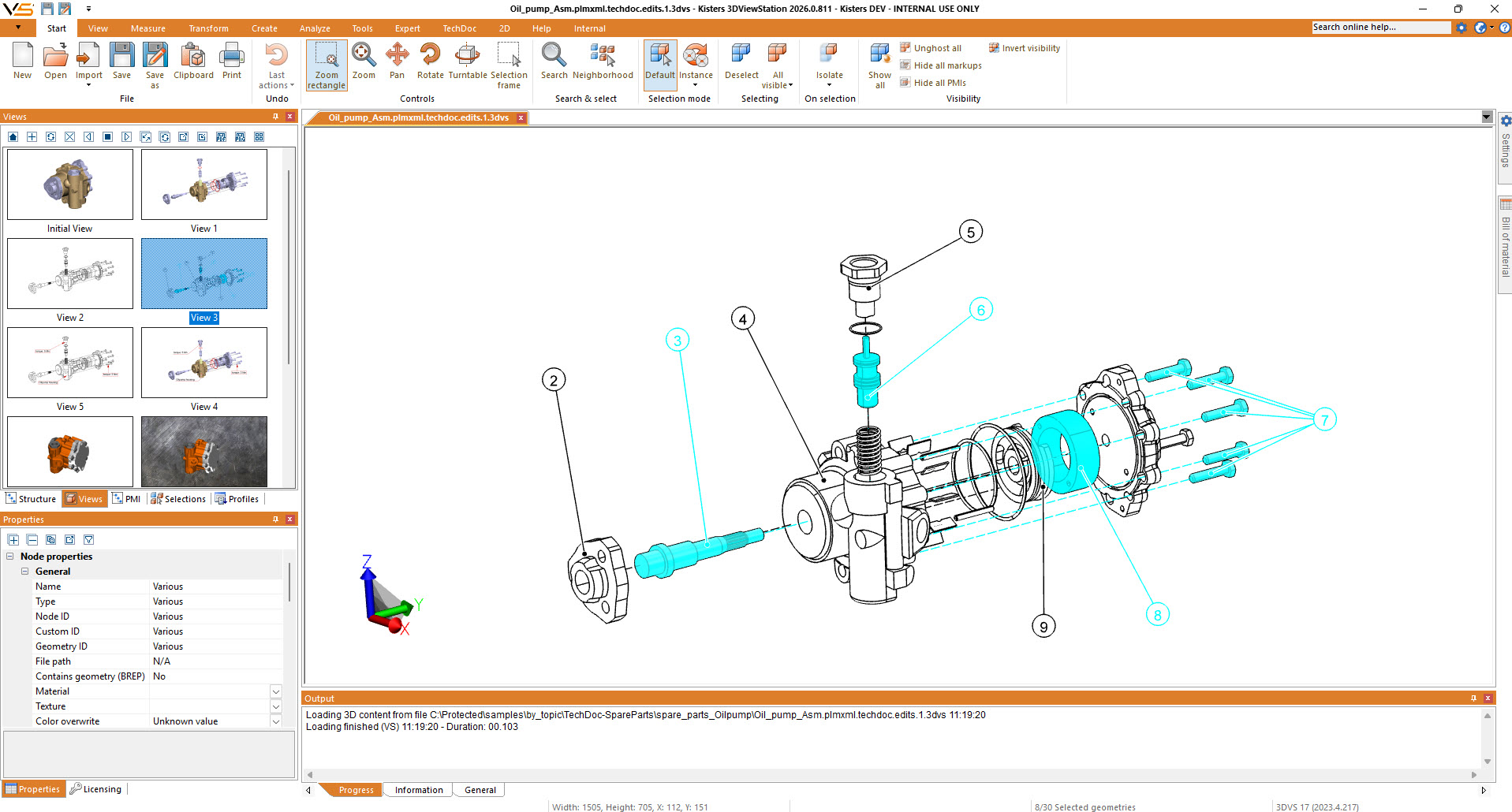
Whether it’s an engine inspection in the hangar or resolving an AOG (Aircraft on Ground) situation, maintenance technicians and repair personnel can access the current digital twin for each part or component directly on their mobile tablets. This enables them to quickly locate part numbers, visually verify disassembly sequences, and directly assign repair instructions on-site.
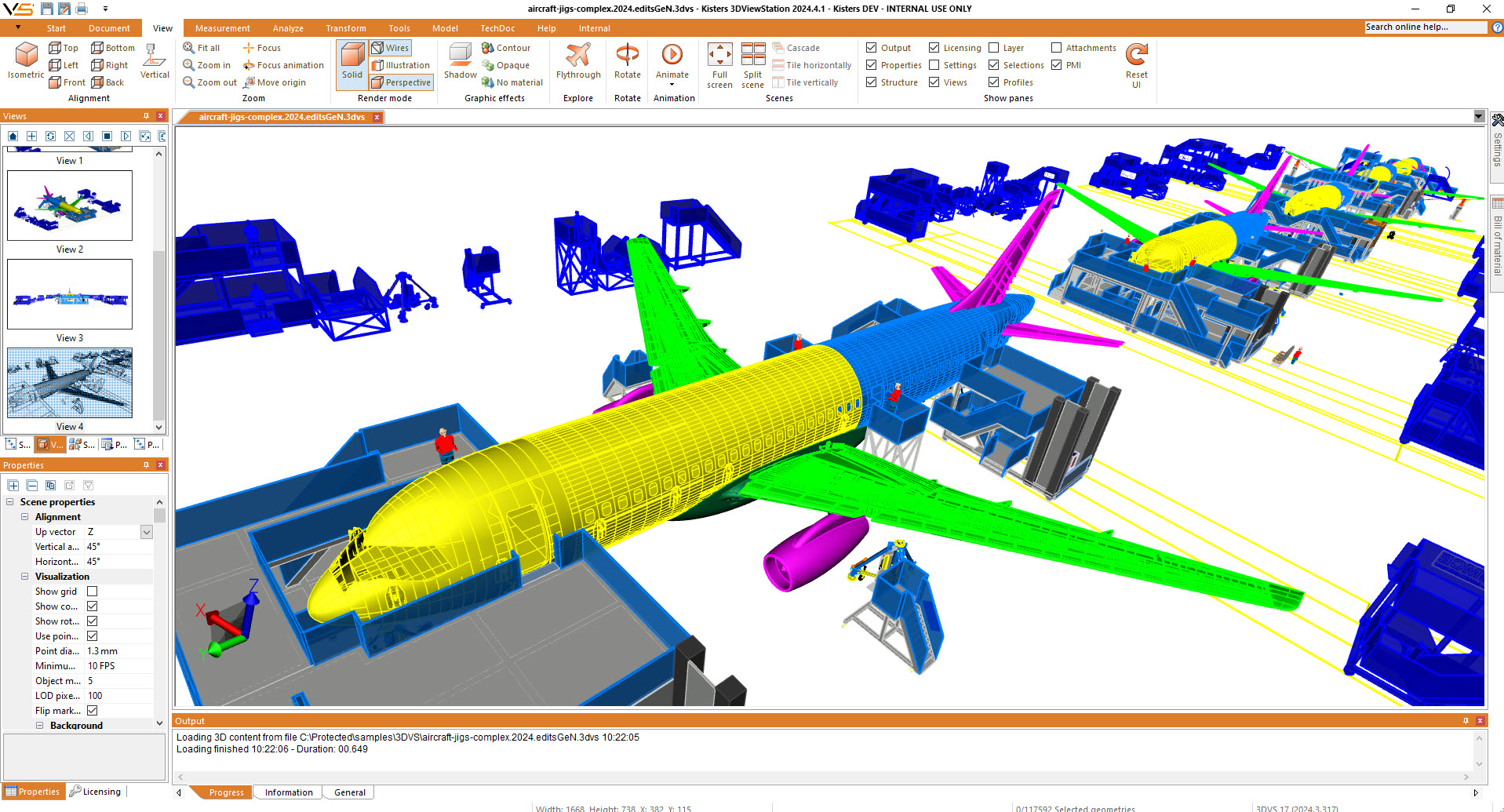

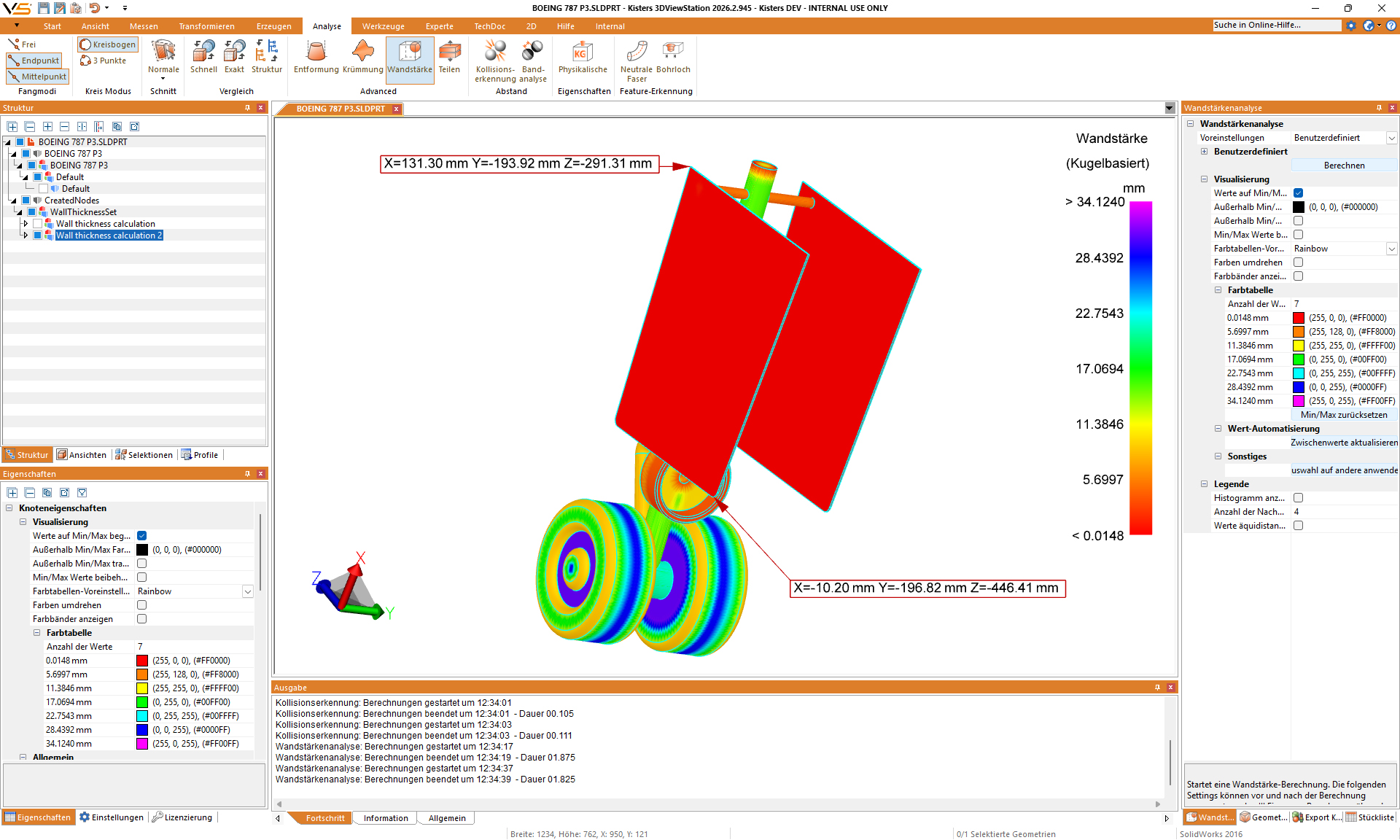
3D CAD Visualization Along the Aerospace Value Chain
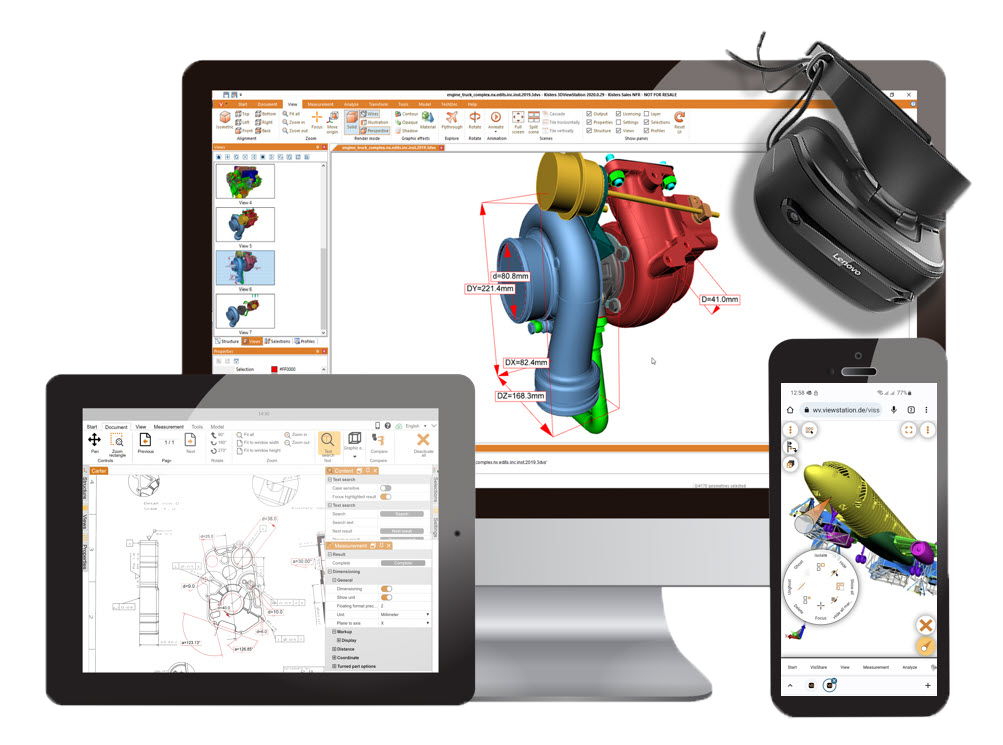
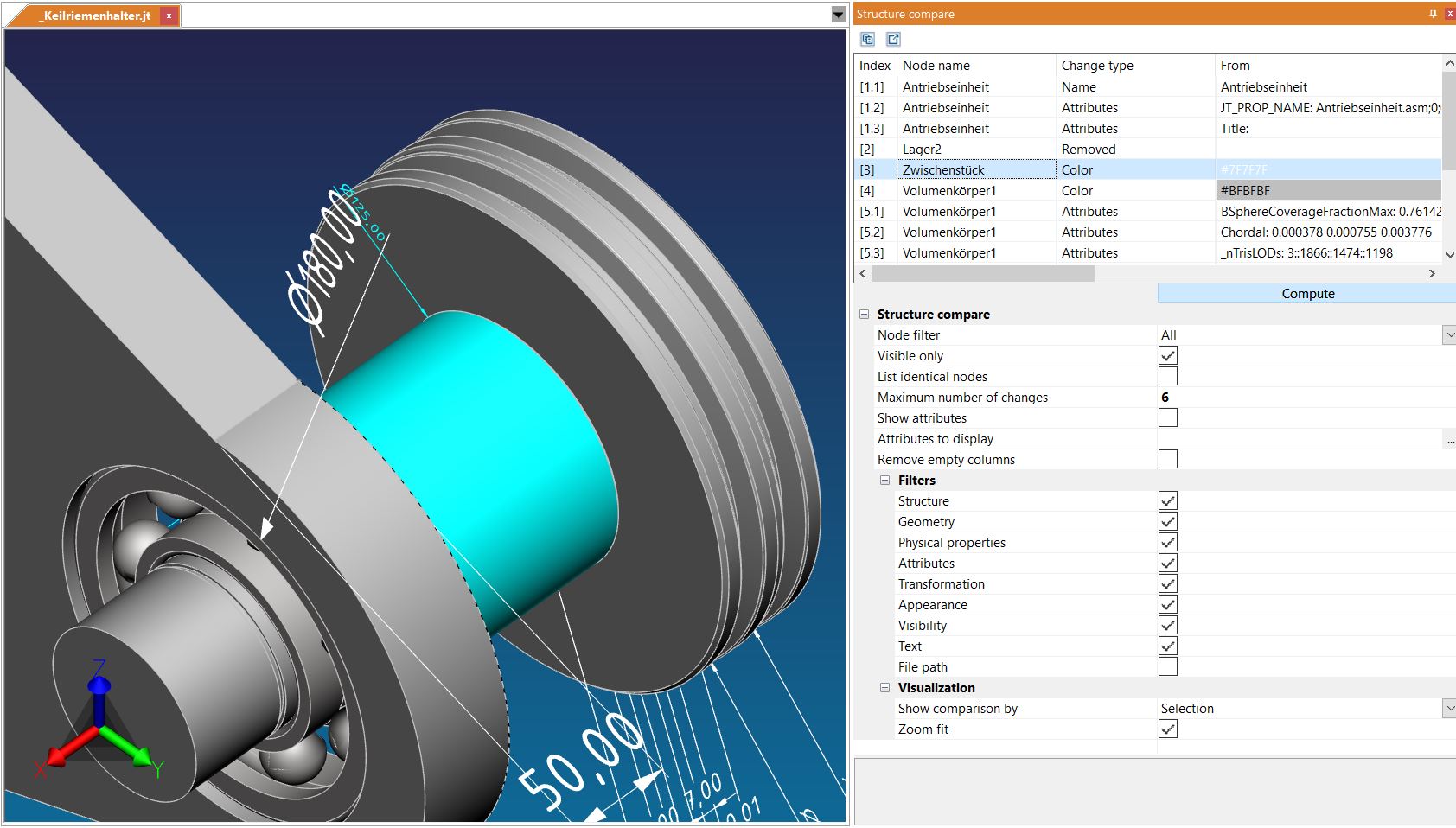
- Design & DMU (Airframe, Engine, Cabin)
- Supply Chain (Tier 1 through Tier 3 Component Manufacturing)
- Final Assembly & FAL (Final Assembly Line)
- MRO & Service (Maintenance, Repair & Overhaul)
Central Visualization Solution:
KISTERS 3DViewStation connects all four phases of the value chain and supports the next generation of aerospace programs and systems through high-performance data access, maximum IP security, and seamless multi-CAD support—enabling seamless, cross-departmental collaboration.
Location-Independent & Flexible: The 3DViewStation WebViewer Edition
In globally distributed aerospace projects, 3D CAD data must be made available regardless of location and without security risks—whether for international suppliers, teams on the final assembly line, or technicians performing MRO work on the tarmac. This is exactly where the 3DViewStation WebViewer Edition comes in: As a cloud-based, browser-based HTML5 solution, it enables browser-based mobile access to massive 3D CAD models for teams around the world from any device (laptop, tablet, smartphone) without the need for local software installation.
Maximum data security and privacy: Sensitive original CAD files remain on secure corporate servers. The system transmits pure 3D pixel streams to the device—eliminating the need for any local download of sensitive geometric data, while fully complying with European data protection requirements, standards, and guidelines.
4 Steps to Precise Assembly Analysis
• Load CAD Data: Directly open native file formats from CATIA V5/V6/3DEXPERIENCE, Siemens NX, PTC Creo, SolidWorks, or neutral standards such as STEP AP242 and JT.
• Visualize & Explore: Navigate smoothly even in complex structural models using the high-performance engine. Utilize exploded views and cross-section planes directly in the viewport.
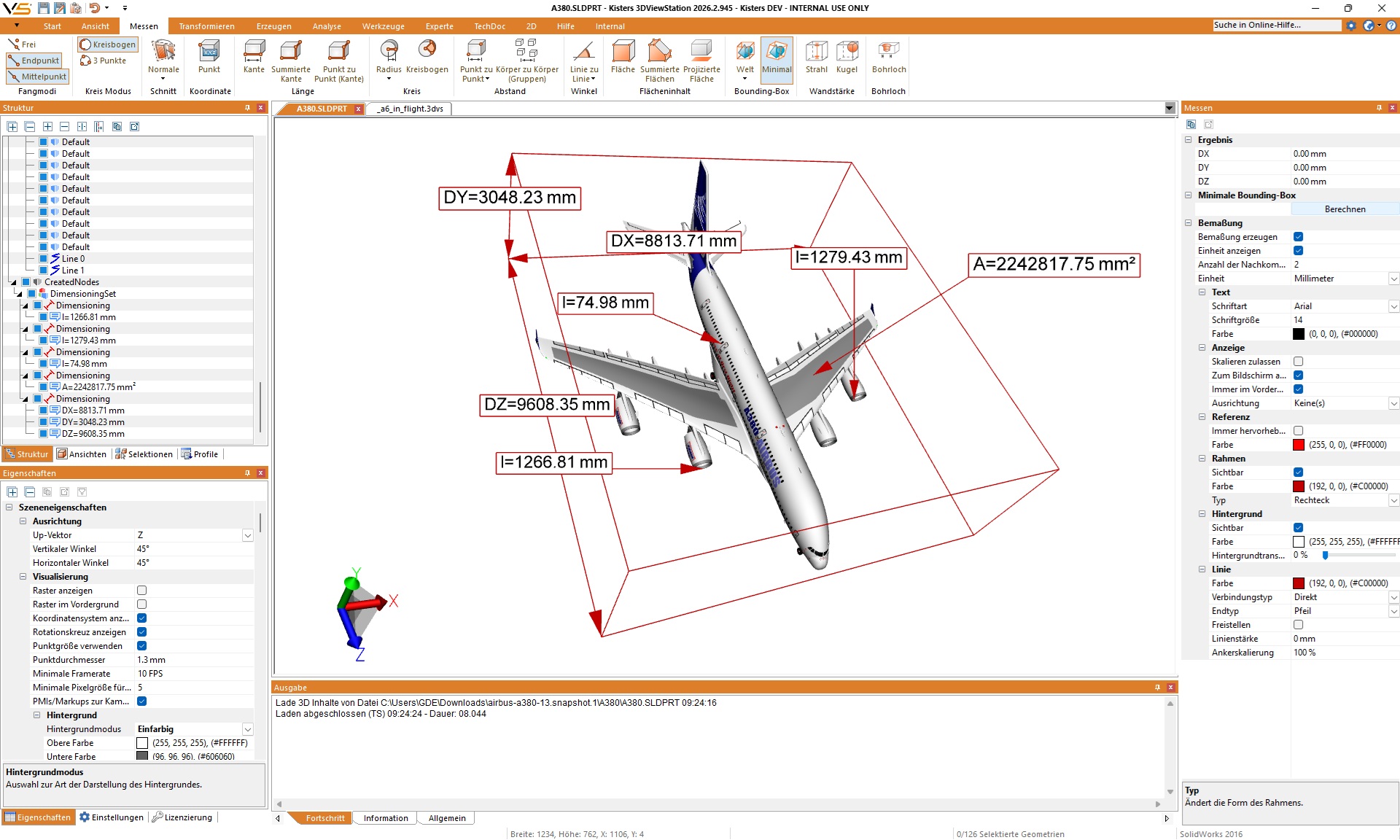
• Measure & Evaluate: Perform precise measurements of distances, radii, angles, and wall thicknesses; extract 3D PMI (form and position tolerances); and visually compare two design stages side-by-side in 3D.
• Document & Share Results: Export annotated views, inspection reports, or protected models (shrinkwrap) for approval by colleagues, partners, or customers.
Operational Scenarios: Who Benefits in the Aerospace Industry?
| Department / Role | Typical Scenario & Scope of Responsibilities | Benefits of 3DViewStation |
|---|---|---|
| Sales & Commercial Bidding | Review of complex bids; determination of construction space and weight. | Quick quotation preparation without time-consuming CAD requests from the engineering department. |
| Work Planning | Feasibility studies and visual assembly planning for the final assembly line. | Error-free process planning based directly on the latest 3D data. |
| Quality Management (QM / QA) | Conducting FAI (First Article Inspection) inspections and AS9100 audits. | Immediate identification of component deviations prior to mass production. |
| Purchasing & Supply Chain | Processing of manufacturing inquiries for global suppliers with full IP protection. | Secure access to protected 3D models without disclosing manufacturing know-how. |
| Maintenance & Service (MRO) | Spare part identification, inspection procedures, and repair documentation. | Faster turnaround times in the hangar and a significant reduction in AOG times. |
Specialized, high-end analysis capabilities for the aerospace industry
While conventional standard viewers reach their limits when it comes to complex tasks, 3DViewStation offers over 180 specialized analysis tools for demanding inspection tasks in the aerospace industry, with a focus on the highest precision:
• Section analyses & clearance checks: Performing precise section cuts through complex engine segments, fuselage zones, or landing gear structures to validate critical minimum clearances.
• 3D PMI & MBD visualization: Complete interpretation of Model-Based Definition (STEP AP242 / JT). Tolerances, manufacturing instructions, and production-relevant metadata are displayed directly on the 3D model.
• 3D Comparison & Reverse Engineering: Automated comparison of two geometries (target vs. actual & 3D scans) using an analysis tool for first article inspection (FAI) as well as for quality-assured reconstruction of older components as part of reverse engineering processes; surfaces can also be specifically inspected.
• Wall Thickness Analyses: Non-destructive identification of material buildup and weak points in CFRP structures and lightweight castings using a visual heat map.
Geometric Anonymization: IP Protection in the Aerospace Supply Chain
Outsourcing the manufacturing of components to external suppliers always carries the risk of unintended leakage of proprietary knowledge. 3DViewStation protects business-critical geometries through automated protection features:
| Protection Function | How It Works in the Aerospace Context | Benefits for the OEM / Supplier |
|---|---|---|
| Subassembly Filtering | Remove internal functional components (e.g., valve internals or cooling channels). | Suppliers receive only external connection dimensions, not internal design details. |
| Tolerance & PMI Stripping | Targeted masking or removal of sensitive manufacturing parameters. | Controlled data sharing with external partners based on authorizat |
Full format support for aircraft and spacecraft manufacturing
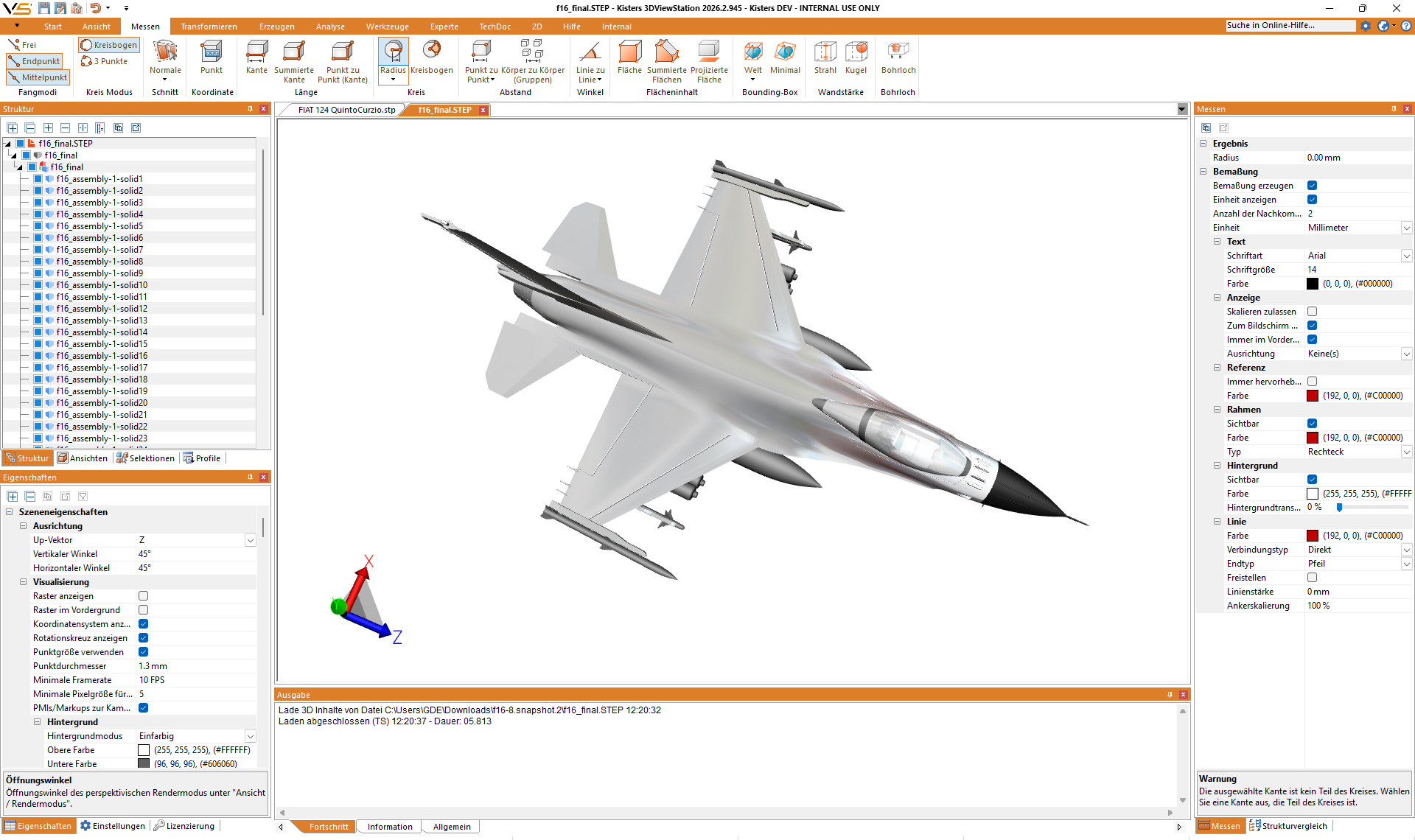
Thanks to native multi-CAD import, the viewer directly supports formats such as CATIA, NX, and SolidWorks, as well as many other well-known CAD formats and industry standards. In this way, KISTERS 3DViewStation enhances compliance with relevant aerospace specifications during data exchange.
• Leading aerospace formats: CATIA V5, CATIA V6, 3DEXPERIENCE, Siemens NX, PTC Creo.
• Open industry standards: STEP (AP242 / AP214 / AP203), JT (ISO 14306), IGES, STL.
• Neutral & lightweight formats: 3D-PDF, PRC, GLTF, FBX, OBJ.
• 2D drawings & schematics: DWG, DXF, TIFF, PDF.

Frequently Asked Questions (FAQ) About 3DViewStation in the Aerospace Industry
Thanks to a high-performance internal 3D data format and a highly optimized rendering engine, 3DViewStation opens even complex digital mockups (DMUs) with millions of components with exceptional performance. Progressive loading algorithms ensure that users can quickly begin measuring, analyzing, or performing automated inspection processes.
Yes. 3DViewStation fully imports integrated 3D PMI (Product and Manufacturing Information) from native CAD systems as well as from neutral formats (STEP AP242, JT). Manufacturing tolerances, annotations, and preset views can be accessed directly on the 3D model without the need for a 2D drawing.
Maintenance teams use the 3DViewStation WebViewer Edition on mobile tablets to access the latest 3D CAD data directly. They can isolate various aircraft components in the viewport, clearly identify part numbers, and visually follow disassembly steps—which significantly reduces downtime (AOG).
Yes. When using the WebViewer Edition, the original CAD files remain on your own secure servers. Only an encrypted pixel stream is provided to the end device. Since no actual 3D geometry data is ever stored locally, the solution is ideal for security-critical environments and complies with strict IT governance policies.
Through open interfaces (APIs), 3DViewStation integrates seamlessly with leading PLM, PDM, ERP, and MES systems such as Siemens Teamcenter, PTC Windchill, Dassault 3DEXPERIENCE, and SAP, while also supporting the automation of downstream processes. This allows employees in quality management, purchasing, and work planning to access validated 3D CAD data directly from their familiar system environment—while complying with strict AS9100 process requirements.
Try KISTERS 3DViewStation for your assemblies
Would you like to see for yourself how quickly your complete vehicle assemblies load? Request a free 3DViewStation trial or schedule a personal consultation.